


THE 3-SECOND HOOK
Your quarterback is not only competing against the defense. He is competing against the transfer portal, national recruiting, and every athlete fighting for the same roster spot.
Talent gets attention.
SKILL DEVELOPMENT GETS TRUST.
College programs want quarterbacks who can process information, protect the football, execute mechanics, lead teammates, and perform inside a system. That is why the coach developing the quarterback matters.
This is the first post in the iDareU Top 10 College Positional Coaches Monday Series. Each week, we will study college coaches only and identify what makes their position development exceptional.
Today, we study QUARTERBACKS.
Research note: This is an editorial 2026 ranking based on current college roles, direct quarterback responsibility, system design, documented player development, passing production, and NFL translation. Coaching staffs can change, so families should always confirm current roles before making recruiting decisions.
WHY COLLEGE COACHES MATTER IN THE TRANSFER PORTAL ERA
The transfer portal changed the recruiting game.
College coaches can now add experienced quarterbacks quickly. That means high school athletes must arrive more prepared. A strong arm is not enough. A highlight reel is not enough. Potential is not enough.
Quarterbacks must show:
- ✓ Repeatable throwing mechanics
- ✓ Fast and accurate decision-making
- ✓ Pocket movement and balance
- ✓ Coverage recognition
- ✓ Leadership and communication
- ✓ Academic preparation
- ✓ The ability to learn a college system
The best college quarterback coaches build all of those traits. They do not simply call plays. They develop complete decision-makers.
THE PORTAL REWARDS READY ATHLETES.
That is why families must choose a team with proven development experience and established relationships with college coaches.
OUR TOP 10 COLLEGE QUARTERBACK COACHES IN 2026
1. CHIP KELLY : OFFENSIVE COORDINATOR, NORTHWESTERN
Chip Kelly remains one of the most influential offensive minds in college football.
His quarterback development stands out because of his ability to simplify complex defensive pictures. Kelly uses motion, formation variation, tempo, and spacing to create clear answers for the quarterback.
His quarterbacks learn to:
- Identify defensive leverage before the snap
- Make fast pre-snap decisions
- Use run-pass options with discipline
- Deliver accurate throws in rhythm
- Attack space instead of forcing coverage
Kelly’s strength is system clarity. He builds an offense that gives the quarterback answers.
For young quarterbacks, the lesson is simple: do not just memorize plays. Understand why the play works.
Read more about current 2026 offensive coordinator changes.
2. SONNY DYKES : HEAD COACH, TCU
Sonny Dykes has earned a reputation as a quarterback developer and offensive program builder.
His quarterbacks are expected to process quickly, throw with timing, and make accurate decisions from a structured system. Dykes emphasizes spacing and rhythm. He wants the quarterback to distribute the football instead of trying to win every play alone.
The development formula is clear:
READ IT. TRUST IT. THROW IT.
Dykes also understands that quarterback development requires confidence. A young passer must be allowed to make decisions, learn from mistakes, and improve without losing command of the offense.
That balance between structure and freedom makes Dykes one of the best quarterback-development leaders in the country.
3. GARRETT RILEY : QUARTERBACKS COACH, MISSOURI
Garrett Riley is one of the clearest examples of a coach whose work directly connects quarterback development with production.
His strengths include:
- Explosive passing concepts
- Quarterback-friendly progressions
- Rhythm throws
- Vertical shot opportunities
- Adjusting the system to the player
Riley has worked with productive quarterbacks at SMU, TCU, and Clemson. His development of Max Duggan and Cade Klubnik helped those quarterbacks become nationally recognized players and legitimate professional prospects.
Riley’s most important lesson is this:
THE SYSTEM MUST FIT THE QUARTERBACK.
A quarterback should not be forced to become someone else. Elite development identifies the athlete’s strengths, then builds those strengths into the offense.
4. JASON BECK : OFFENSIVE COORDINATOR, MICHIGAN
Jason Beck brings a power-spread approach that demands physicality, discipline, and quarterback command.
His quarterbacks must understand the run game, control pre-snap checks, and make accurate throws when defenses load the box. That creates a complete development environment.
Beck’s approach teaches quarterbacks to:
- Read the box count
- Recognize pressure
- Use cadence with purpose
- Manage run-pass conflicts
- Make the correct decision quickly
That is college quarterback training at its core. The quarterback is not just a passer. He is the operating system of the offense.
Review national coverage of the 2026 coordinator landscape.
5. DREW MEHRINGER : OFFENSIVE COORDINATOR, OREGON
Drew Mehringer enters 2026 with a major responsibility: continue developing quarterbacks inside one of the country’s most aggressive offensive environments.
Oregon’s approach demands precision at full speed. Quarterbacks must operate with tempo, identify coverage quickly, and make accurate throws while defenses are moving.
Mehringer’s development emphasis centers on:
- Tempo execution
- Efficient communication
- Spread formations
- Quick-game accuracy
- Explosive-play decision-making
The lesson for Atlanta quarterbacks is powerful: SPEED OF PLAY MUST COME FROM PREPARATION.
Fast does not mean rushed. Fast means prepared.
6. MIKE DENBROCK : OFFENSIVE COORDINATOR, NOTRE DAME
Mike Denbrock has built a reputation as a creative offensive coordinator who understands how to develop quarterbacks within a balanced attack.
His quarterbacks must throw effectively, manage the run game, and make smart decisions in high-pressure situations. Balance matters. A quarterback who can only succeed in one type of play becomes predictable.
Denbrock’s approach teaches:
- Formation recognition
- Play-action discipline
- Pocket patience
- Ball placement
- Situational football
College coaches want quarterbacks who can win in multiple ways. Denbrock’s systems help develop that versatility.
7. NICK SHERIDAN : OFFENSIVE COORDINATOR, MICHIGAN STATE
Nick Sheridan brings direct quarterback-coaching experience into the offensive coordinator role.
That background matters. A coach who has worked closely with quarterbacks understands the daily details: footwork, throwing base, eye discipline, communication, and confidence.
Sheridan’s quarterback development emphasizes:
- Fundamentals before flash
- Clear progression reads
- Efficient footwork
- Protection communication
- Consistent execution
MECHANICS CREATE REPEATABILITY.
A quarterback who repeats the same footwork and release can improve accuracy, timing, and decision-making. That is how skill development competes with the transfer portal.
8. KENDAL BRILES : OFFENSIVE COORDINATOR, SOUTH CAROLINA
Kendal Briles is known for designing aggressive, quarterback-friendly offenses.
His systems create opportunities for mobile quarterbacks to use their legs while still developing as passers. The quarterback must understand when to attack vertically, when to take the checkdown, and when to protect the football.
Briles’ coaching strengths include:
- RPO decision-making
- Tempo
- Quarterback run concepts
- Defensive manipulation
- Explosive passing opportunities
The key lesson is discipline. Dual-threat quarterbacks cannot turn every play into a scramble drill.
USE YOUR ATHLETICISM. DO NOT DEPEND ON IT.
9. CRAIG STUTZMANN : OFFENSIVE COORDINATOR, SAN JOSE STATE
Craig Stutzmann’s offenses have produced strong passing numbers, including top-level national passing production in recent seasons.
His quarterback development stands out because of its emphasis on throwing volume, timing, and offensive rhythm. Quarterbacks in this type of system must be decisive.
They must:
- Set the protection
- Identify the coverage
- Throw on schedule
- Attack matchups
- Recover quickly after mistakes
Production is not accidental. It comes from preparation, structure, and repetition.
10. CLINT TRICKETT : OFFENSIVE COORDINATOR, JACKSONVILLE STATE
Clint Trickett brings a quarterback perspective shaped by his own playing experience and offensive coaching background.
His development philosophy highlights mobility, toughness, and playmaking. Quarterbacks must be comfortable operating from different launch points and making decisions under pressure.
Trickett’s approach teaches young quarterbacks to:
- Move with purpose
- Keep their eyes downfield
- Protect the football
- Create second-reaction opportunities
- Compete through contact and adversity
That mental toughness matters. College football is demanding. Quarterbacks must be technically sound and emotionally steady.
THE iDAREU QUARTERBACK SKILL: RESET YOUR PLATFORM
This is one teachable skill every quarterback can begin developing today.
Skill: Resetting your feet before the throw.
Exact Drill Steps
- Place one cone at the quarterback’s normal throwing position.
- Place two additional cones 2 yards to the left and right.
- Start in a balanced quarterback stance.
- Take a three-step drop while keeping your shoulders level.
- Shuffle toward the coach’s verbal direction: “left,” “right,” or “reset.”
- Return your feet to shoulder width before throwing.
- Keep your front shoulder pointed at the target.
- Throw five passes to the left target and five passes to the right target.
- Record completion percentage and throws made without drifting backward.
- Repeat for three rounds.
Common Mistake
The most common mistake is throwing while drifting backward or leaning away from the target.
Correction
Stop the feet before starting the throw. Reset the base. Transfer weight from the back foot to the front foot. Keep the chest over the knees.
Measurable Outcome
Track 30 total throws.
A strong short-term goal is:
- At least 24 accurate throws out of 30
- Fewer than 3 throws made while drifting backward
- Consistent release point across all three rounds
This is the type of measurable quarterback training college coaches value. It is not flashy. It is repeatable.
WHAT THIS MEANS FOR ATLANTA FAMILIES
At iDareU Academy, our athletes study the same fundamentals elite college quarterback coaches demand.
We teach mechanics. We teach reads. We teach leadership. We teach preparation.
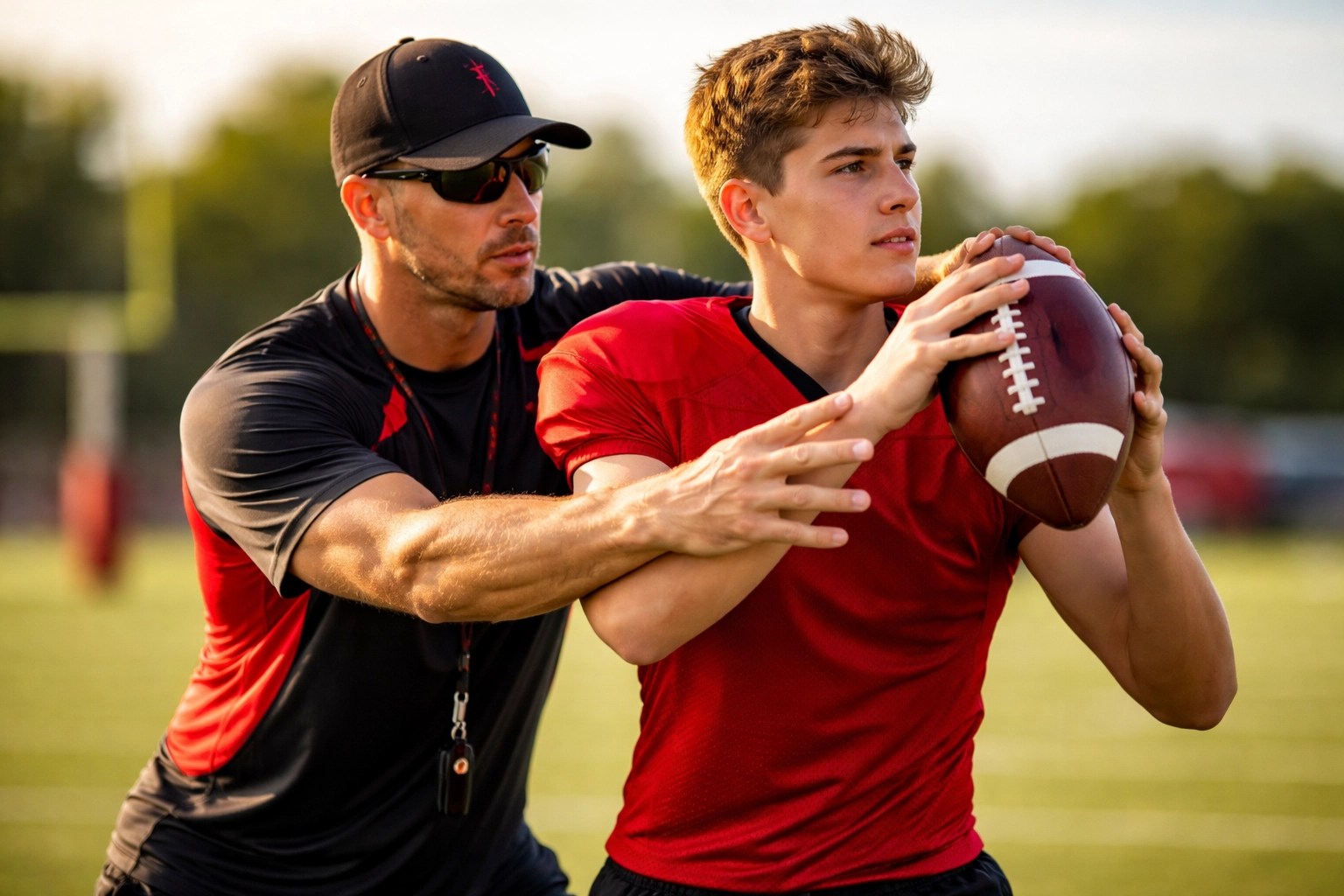
Our quarterback development program is led by Zerrick Cooper, a former NCAA Division I quarterback and current Quarterback Development Director. His instruction focuses on mechanics, football IQ, confidence, accountability, and character.
This is not random football training.
This is targeted development for athletes ages 10–18 who want to compete at a higher level.
iDareU Academy has been building athletes and students since 2006.
Our proof points:
- ✓ 20-year track record
- ✓ 400+ collegiate placements
- ✓ $52M+ in scholarships
- ✓ 25+ NFL alumni
- ✓ 98.5% graduation rate
- ✓ #1 Positional Training Organization
- ✓ Professional athlete relationships, including our partnership with Julio Jones
“We been with iDareU for so long I done forgot how long we been out here. My lil cousins came through this program and both of them went Power 5, and by the way it going my two sons have a chance also.”
: Randy Willingham, iDareU parent

RECRUITING RELEVANCE: SKILL DEVELOPMENT BUILDS OPTIONS
The transfer portal makes college roster competition tougher.
Your athlete cannot control every roster decision. Your athlete can control preparation.
Quarterbacks who develop early create more options. They can compete for camps, evaluations, depth charts, and recruiting conversations. They also become easier for college coaches to project.
That is why parents should not gamble on generic workouts or temporary exposure.
Get with an organization with a proven track record to help guide your child in the right direction. Don't Gamble On Your Child's Future.
iDareU is family.
We have spent 20 years building relationships, developing athletes, supporting academics, and helping families navigate the college process. Our mission is bigger than one season. We are preparing athletes for the game, the classroom, and the 5th Quarter of life.
BOOK YOUR FREE WORKOUT
Your quarterback’s next level starts with the right instruction.
Book a Free Workout or Fill Out the Athlete and Parent Inquiry Form.
Explore iDareU football training, connect with our 20-year story, and let us help your athlete build the skills college coaches demand.
Call/Text: 4048005048
Mon–Fri, 9am–6pm ET
www.idareu.org
WE BUILD MONSTERS. iDAREU IS FAMILY.